
Observations
The section below summarises some of the discussions that were had at the workshop when interacting with participants. A major reason for the workshop was to gain insight from participants about their requirements for improving access in higher education in Bangladesh. This allows the Accessible Academy team to focus on the most important development in the courses.
Attitudes to Declaring Disability
Discusses challenges faced by students with disabilities (hearing, vision) in Bangladesh. Key points:
- Many students hesitate to disclose disabilities due to social stigma.
- Universities should clearly announce available support and collaborate with counselling centers.
- Accessibility tools should be user-friendly and widely available.
Ethics
Outlines ethical principles for AI use:
- Core values: human rights, inclusiveness, environmental responsibility.
- Key principles: proportionality, privacy, transparency, accountability, sustainability.
- Emphasizes awareness and literacy to bridge the digital divide and ensure fairness and non-discrimination.
Referencing
Highlights issues with AI-generated references:
- Tools like ChatGPT often produce fake or incorrect citations.
- Educators need verification mechanisms (e.g., CrossRef, DOI checks).
- Suggests using tools like Perplexity for better accuracy.
- Warns against blindly trusting AI-generated references
Posters
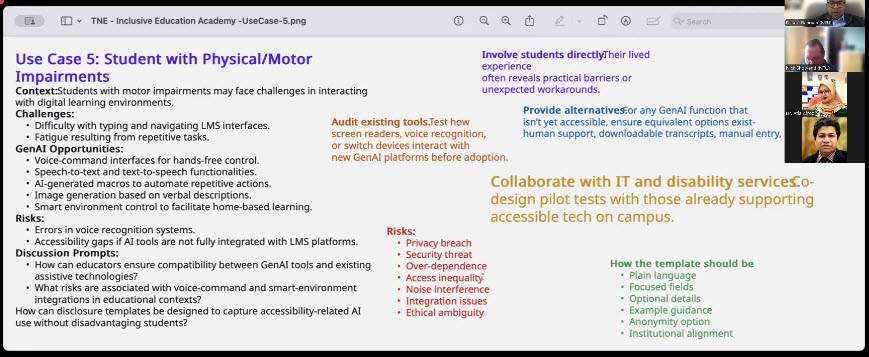
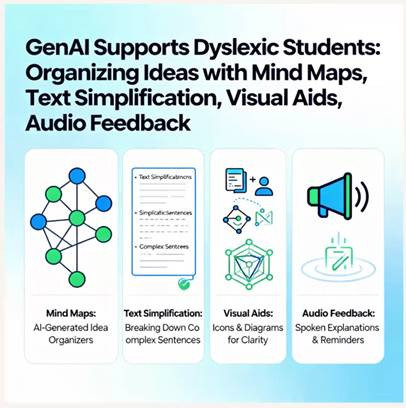
Creation of posters with steps to support hidden disabilities would be useful. The following examples were produced:
Last modified: Thursday, 16 April 2026, 10:01 PM