
Section outline
-
Course Format
- Duration: Approx. 2–3 hours
- Delivery: Self-paced online
- Materials: Videos, readings, interactive tools
- Assessment: Prompt practice, ethical reflection, application task
-
-
UNESCO — Guidance for Generative AI in Education & Research.
OECD — AI Principles & AI Policy Observatory.
IEEE — Ethically Aligned Design.
ISO/IEC — 23894 (AI risk management), 42001 (AI management systems).
UDL (CAST) and WCAG 2.2 for accessibility.
-
-
-
Accessibility (UDL/WCAG 2.2): Provide text alternatives for media; offer plain‑language versions; ensure colour contrast; caption videos; provide transcripts; allow alternative submission formats.
Academic integrity: Prefer process‑evidence and authentic tasks; avoid AI‑detector tools as determinative evidence; use vivas/portfolios where appropriate.
Privacy & data: Do not upload confidential or sensitive data; anonymise where feasible; follow institutional policies; disclose AI use transparently.
-
-
-
-
Understand the definition and scope of AI.
Identify key categories: Machine Learning (ML), Deep Learning (DL), Generative AI (GenAI) and Large Language Models (LLMs)
-
-
-
-
Video 1: Generative AI Explained in 5 Minutes | What Is GenAI?
- Duration: 5:02
- Description: A concise introduction to generative AI, explaining what it is, how it works, and its key applications across industries, including education. Perfect for learners who need a foundational understanding before diving deeper into its implications for teaching and learning.
Video 2: Generative AI in Education: The Future of Teaching and Learning
- Duration: 3:13
- Description: This video provides a quick overview of how generative AI is reshaping education. It highlights practical benefits such as personalized learning experiences, reducing administrative burdens for educators, and enhancing teaching roles rather than replacing them. Ideal for sparking discussion on the positive potential of AI in higher education.
-
Reactive Machines – Basic AI systems that respond to inputs (e.g., chess-playing programs).
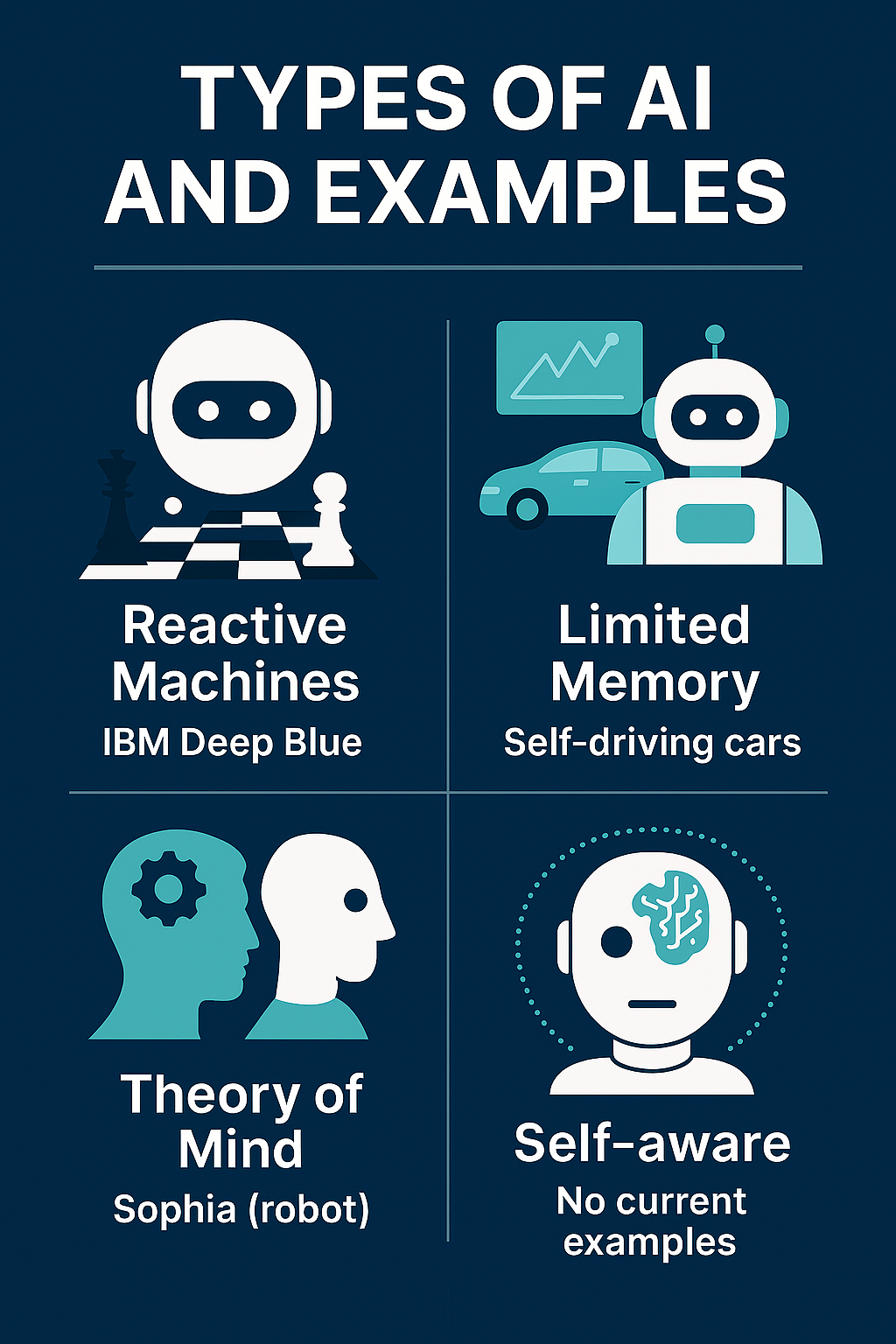
Limited Memory – AI that learns from historical data (e.g., self-driving cars).
Theory of Mind – Future AI aiming to understand emotions and intentions.
Self-aware – Hypothetical AI with consciousness.
-
-
-
-
-
-
Understand how Generative AI and LLMs work.
Explore popular tools: ChatGPT, Copilot, Claude, Gemini.
-
-
-
Tutorial: How LLMs Generate Text.
Reading: Use cases in Higher Education.
Examples: Chatbot vs. Assistant vs. Agent.
-
-
-
-
-
Apply AI tools in teaching, learning, and admin tasks.
Design AI-enhanced activities and workflows.
-
-
-
AI-Enhanced Lesson Builder.
Feedback Simulation.
Admin Task Planner.
-
-
-
-
-
Recognise ethical risks: bias, misinformation, privacy.
Understand the environmental impact of AI.
-
-
-
Video: "Ethics and Sustainability in AI"
Reading: Responsible AI use in education.
Case Studies: Ethical dilemmas and solutions.
-
Reading: Responsible AI Use in Education
- AI introduces ethical challenges such as bias, misinformation, and privacy concerns. Educators must ensure transparency, fairness, and accountability when integrating AI tools.
- Key principles:
- Bias Mitigation: AI models can perpetuate stereotypes. Validate outputs and diversify training data sources.
- Privacy Protection: Avoid sharing sensitive student data with third-party tools.
- Academic Integrity: Establish clear guidelines for AI-assisted work.
- Environmental Impact: Large AI models consume significant energy. Opt for efficient tools and limit unnecessary queries.
- Frameworks like UNESCO’s AI Ethics Guidelines and institutional policies should guide practice.
-
Video: AI Ethics 101: What Educators and Students Should Know
Duration: 5:53
License: Creative Commons
Overview: Covers fairness, transparency, accountability, privacy, and responsible AI use in education. Includes practical questions for reflection. -
Case Studies:
-
Example 1: AI-generated feedback introducing bias.
-
Example 2: Carbon footprint of large-scale AI deployments.
-
-
-
-
-
Bias Spotting Challenge: Review AI-generated text for biased language.
Privacy Policy Review: Compare two AI tool policies and identify risks.
Carbon Footprint Estimator: Calculate energy use for AI queries and discuss sustainability strategies.
-
-
-
-
-
Identify limitations of GenAI and LLMs.
Develop critical thinking when using AI outputs.
-
-
-
Reading: Common errors and hallucinations.
Video: "Why AI Gets It Wrong"
Checklist: Evaluating AI-generated content.
-
-